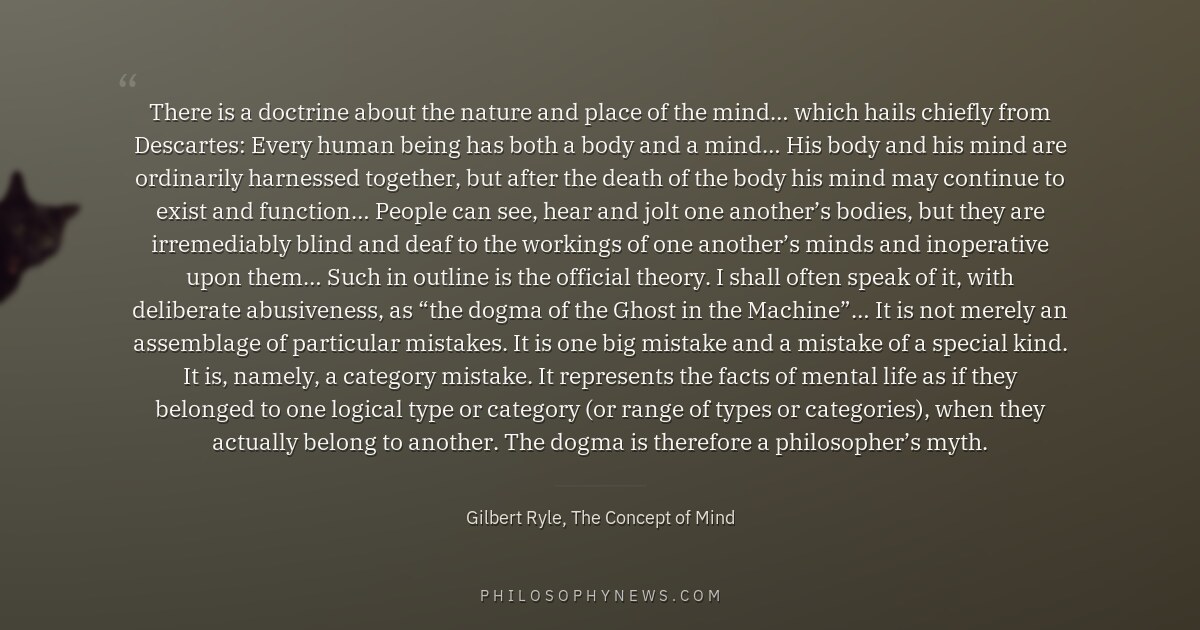
“There is a doctrine about the nature and place of the mind… which hails chiefly from Descartes: Every human being has both a body and a mind… His body and his mind are ordinarily harnessed together, but after the death of the body his mind may continue to exist and function… People can see, hear and jolt one another’s bodies, but they are irremediably blind and deaf to the workings of one another’s minds and inoperative upon them… Such in outline is the official theory. I shall often speak of it, with deliberate abusiveness, as “the dogma of the Ghost in the Machine”… It is not merely an assemblage of particular mistakes. It is one big mistake and a mistake of a special kind. It is, namely, a category mistake. It represents the facts of mental life as if they belonged to one logical type or category (or range of types or categories), when they actually belong to another. The dogma is therefore a philosopher’s myth.”
— Gilbert Ryle, The Concept of Mind
Poststructuralism as a Regime of Truth: Foucault and the Paradox of Philosophical Authority
Foucault’s critique of power and knowledge shaped poststructuralism, yet its rejection of truth risks becoming its own orthodoxy. To remain...