This post was originally published on this site.
I’m a professor who is banning AI in my classroom this semester.
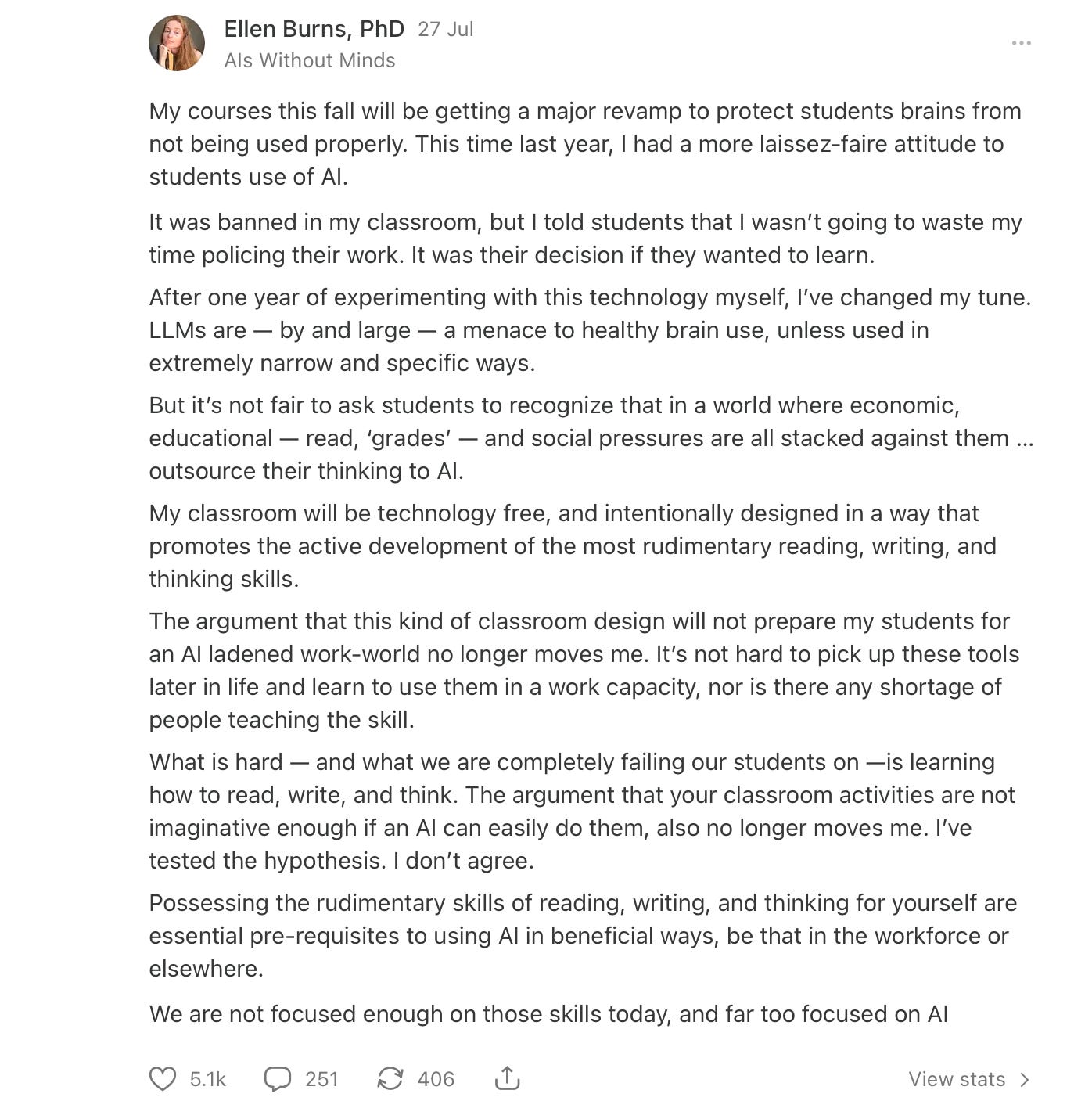
A note of mine recently got a lot more attention than expected. It was a regular Tuesday. I’d been reading some excellent work in the Atlantic by Rose Horowitch warning us that ‘the end of reading is here’. I decided that enough was enough. I needed my classrooms, especially my first year classrooms, to be tech-free.
Allowing the internet to hold me accountable, I told the world that my courses would be changing this semester. The responses and level of engagement surprised me
I started teaching full-time at university level in Fall of 2025. I had just defended my PhD, and I wasn’t at all prepared for the effects of AI on my students’ learning.
When Chat GPT burst onto the scene in late 2022, I was on my fellowship year at Columbia, which meant that I did not teach and received a stipend to support myself while writing my PhD. I vaguely remember panic in what’s app groups from fellow grad students who were not in their fellowship year, who were TA’s (‘teaching assistants’) when Gen AI first became mainstream.
Aside from that, I lived in blissful ignorance. As someone who loves learning, it was a wonderful year for me. I spent most of my days in a library reading and writing, or in a swimming pool swimming and thinking. It’s also the year I met my now husband.
In my bliss, I ignored the panic, in part because I was free to think and write without teaching responsibilities, in part because I was engrossed in my dissertation, in part because I wrongly assumed the panic was exaggerated, that this would all ‘blow over’.
The following years that I served as a teaching assistant, and then primary instructor, at Columbia, I continued to bury my head in the sand. I have always been a lover of books and learning, and I had no interest in the technology.
But more deeply than that, if I’m being honest, I was already exhausted and burnt out trying to get my own PhD written (there are many privileges that come with getting a PhD, and there are many stressors too). I was teaching, finishing up a PhD, and on the job market, sending out far too many applications than should be necessary in the hopes of securing a job to pay my rent and feed myself come graduation.
Was it really on me, in this moment, I thought to myself, a burnt out PhD student, to save the youth from AI and its harms?
Graduate school took a toll on my mental health. Especially in those final years. So, as someone who had finished secondary school (that’s Irish-English for high school) at a time when we used pen and paper for everything, I happily ignored AI right up until I graduated from Columbia with my PhD.
At 17 and 18, I had mountains of notes, ideas, lessons, and thoughts, physically written down and stored away in different parts of my desk. Obviously, it took me hours and hours to write these kinds of notes, but I was studious, loved learning, and took pride in how colourful and organised my notes were.
I had virtually no tech distractions (sure, there was Facebook or whatever, but I was lucky enough to have real friends, who I would spend real time with, and my phone was a block with nothing much on it). I was happy to be tech free.
Moreover, the kind of cognitive and physical labour that was required of me to take these kinds of notes, also meant that these thoughts, ideas, and lessons were not just stored on paper, they were stored away in my brain, which was being appropriately exercised for the kind of cognitive development that an 18 year old brain requires.
In college, I had a laptop —though nothing too fancy — but I would only really use it to write papers. By the time I got to grad school, my laptop got a little fancier (I invested in a Mac) but frankly, I was so immersed in pen and paper, books, and of course, the internet, for most of my life, that when AI came on the scene, it never even entered my mind to use it. In fact, I barely looked at the technology until 2025.
I realise now that my lack of temptation to use AI was an enormous privilege. To be so disinterested in a technology that promised to make my life, thinking, and work more ‘productive’, ‘efficient’, and whatever other lies are sold to us today, reflected decades of dedication from teachers, professors, and parents, to my education and learning.
In my first year as a full professor, I was still tired from graduate school, and didn’t really know how to handle AI use in my classroom. On one side, I would hear people claim that I was not preparing my students for the real world if I banned AI use, a line I was fiercely sceptical of, but figured I should test; on the other side, even when I was banning AI use, I didn’t see the point in policing it in the name of ‘education’.
I was also settling into my first ‘real job’ as people like to say of newly minted PhDs (good one, I’d had several jobs for the past 7 years of my PhD program). Because I already had a lot on my plate. I decided to ban AI in my classrooms, but I was explicit with students that I wouldn’t waste my time policing their use of AI.
As a young professor, I am subject to at least some of the same stressors as my students: a terrible economy, unstable work, the pressure to excel, etc.
Two things happened in 2025. I came on Substack in November and started writing about AI, not in an educational capacity but as it relates to the philosophy of mind and questions of consciousness. I also witnessed troubling patterns in student assignments (the same idea magically appearing in ten different papers, suspiciously well written objections to an argument, that kind of thing).
Moreover, I witnessed push back when I expressed scepticism towards using AI in my own writing. ‘This article could do with a good AI edit’, something to this effect was a comment I received on an early Substack piece. That really stopped me in my tracks.
Is that really what we are focused on today? A good AI-edit?
With all of this going on, and as I wrote more on AI, I began experimenting with the technology myself. I wanted to experience what this technology would do to my brain, how it might change my behaviours, or my thinking, and whether it was in fact true that I was doing a disservice to my students in banning its use in the classroom.
After a year of engaging with this technology, I cannot say I was impressed with the results—and before anyone comes at me in comments, when I say ‘AI’, yes, I mean corporate LLMs, and when I speak to the effects of these corporate LLMs in my own life, yes, I am aware that there are other ways to use the models (that I could, if I wanted to, work to integrate them into my workflow in helpful ways, etc).
My experimentation with this technology was not to figure out how to incorporate it into my workflow in effective ways (I won’t be doing that in any serious way, sorry).
It was to see what happens when you engage with this technology the way the overwhelming majority of people are being told to engage with it (open a chat bot, ask it to help you in a variety of ways, try to prevent it from making bad decisions for you by writing instructions for it, etc).
It was to see what happens when you advertently or inadvertently outsource decision making to it, outsource judgement to it, or give it an inchoate idea and try to expand on it with an LLM instead of with other books, people, and your own imagination.
There is much I could say here, but overall I found its effects were overwhelmingly negative. I noticed my memory foundered on topics that I engaged with LLMs on, far more than on topics that I didn’t. I found it to be so bad at producing good judgement or decision making that I would use up more of my time managing the poor judgements of the machine than actually getting to develop my own good judgement.
I found its ‘ability’ to help form inchoate ideas into richer ones to be poor. I cannot think of a single time that engaging with an LLM on an idea lead to anything other than dead ends and wasted time, something that rarely happens when I follow my own intuitions and creativity in thinking through ideas and projects.
(and yes, for those of you in business, this issue is surely happening whole scale for you too — you can talk to me about this if you like).
I am one year out of graduate school with a one year contract to teach this coming fall, and no promise of a paid income after that.
I am 32 years old since August. That makes me just 14 years older than the 18 year olds who have grown up in a world where LLMs are saturating every aspect of their education. I have no idea what I would have done at 18, if I lived in their world.
I’ve heard from several young people that professors are often critical of them, and consider them ‘lazy’ in their attitudes towards learning and AI.
I find it disappointing that the burden seems to be falling on 32 year old me — who in the grand scheme of things, still feels pretty young, dumb & broke— to step up and turn my 1 year teaching contract into a space where I can facilitate people born just 14 years before me, getting a real education.
I want to be clear, I am not suggesting I am a martyr, that I am the only professor doing this —the amazing support and comments I’ve seen on this note of mine shows me I am far from alone — or even necessarily, that younger professors are feeling the brunt of this issue, more than established professors.
Rather, I am telling my own story in the hopes of highlighting how the education system is failing students and professors alike, albeit with different consequences for each of us. Because what would benefit students more, universities investing in AI, or universities giving contingent professors permanent jobs?
And what would help students more, believing that the system is stacked against them, and that it is all too easy to outsource their education to AI —an education that is increasingly reduced to the pressure of good grades, and preparing them for a job — or believing that our students are ‘lazy’?
It is a convenient myth to believe that 18 year me, or any other 18 year old born in the 60s, 70s, or 80’s, would not have been tempted or allured into using AI had they been born into the social and economic environment that today’s youth have been born into. Our students do not need universities to invest in AI. They need universities to invest in professors. And our students do not need professors to be judging them for their AI use. They need their professors to create the conditions in which students today can get the kind of education that older generations were lucky enough to get.
Photo by Susan Q Yin on Unsplash