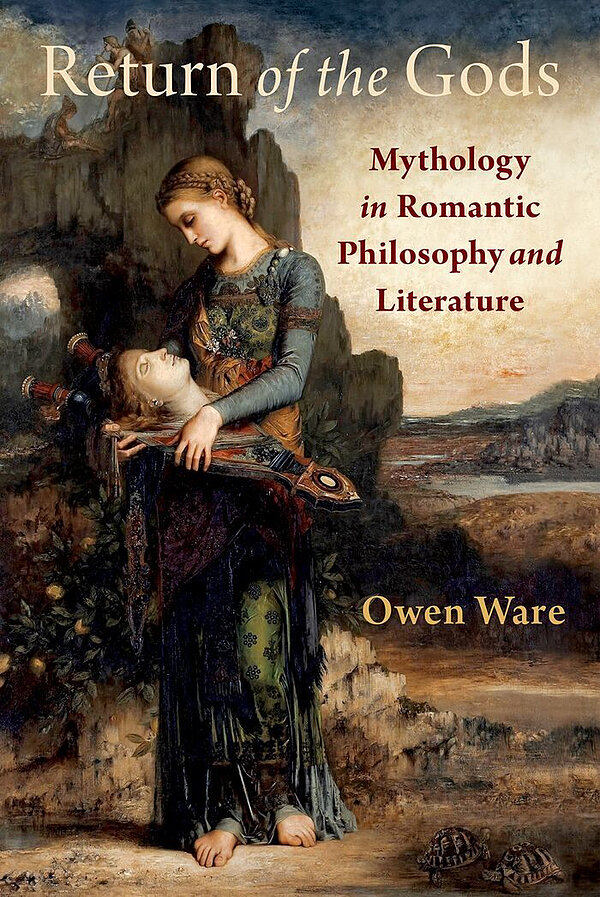
Owen Ware’s new book on mythology in romantic philosophy and literature begins—how could it not?—with the famous poetic appeal to Greek myth in Schiller’s Die Götter Griechenlands. On Ware’s view, Schiller’s poem, which had a wide influence over a younger generation of thinkers including Schelling and Hegel, represented a call not so much to imitate pagan models of beauty as to grasp “a truth of a special kind, which the modern world urgently needs”. This truth, Ware argues, is a “truth about the unity of human beings that has been forgotten, a vision of our capacity to live in harmony with ourselves, with others, and with the world” (3). Philosophically, Schiller’s appeal to myth, as Ware sees it, should thus be viewed not as looking nostalgically backwards to some (“naïve”) immediacy that Schiller thought it impossible simply to recover from the ancient world, but rather forward to the ways in which modern life might reconcile reason and sensibility.
In the existing scholarly literature on romanticism’s philosophical importance, the movement generally categorized as early German romanticism—that is to say, the romanticism centered especially on the heyday of Jena and that crystallized in the writings of Friedrich Schlegel, Novalis, Schleiermacher and others—has rightly been distinguished from the later and often politically problematic appeals to romanticism that emerged in subsequent decades in nineteenth and twentieth century Germany. Yet early German romanticism is hardly a movement without important later philosophical family connections, including among the English romantics. It’s a helpful facet of Ware’s book then that he draws significant connections between figures like Coleridge and Wordsworth (who in fact traveled together to Germany in 1798-99 in hopes of meeting Schiller), as well as to poets like Blake and next-generation romantics like Keats and Shelley who had less direct experience with the earlier German tradition. (As it turns out, however, even the English figures with less exposure to Germany have some surprising moments of inspiration from the German tradition: Blake made a remarkable set of notations on his friend Henry Fuseli’s translation of Johann Caspar Lavater’s Aphorisms on Man and was similarly inspired by Winckelmann, while Shelley drew on A. W. Schlegel’s famous lectures in aesthetics as well as the writings of Madame de Staël.)
Ware’s book is divided into chapters that fill in key moments of this development, alternating between Germany and England. From his start with Schiller, he moves to the project of a “new mythology” as sketched in the famous manifesto of Das Älteste Systemprogramm des deutschen Idealismus (the so-called “Oldest System-Program of German Idealism”, a document curiously written in Hegel’s hand but whose authorship is disputed and which Ware takes ultimately to be Schelling’s) as well as in Friedrich Schlegel’s Gespräch über die Poesie and Schelling’s System of Transcendental Idealism (both published in 1800). The following chapter then turns to Blake, Coleridge and Wordsworth, followed by an interpretation of three German novels centered on poetic self-discovery (Hölderlin’s Hyperion, Schlegel’s Lucinde and Novalis’ Heinrich von Ofterdingen); and then finally to Keats and Shelley, culminating in a reading of the Prometheus Unbound.
Among all of these writers, Ware discerns a deep-seated concern with the modern problem of fragmentation—or really self-fragmentation—as a touchstone. The key motif is differently described by different writers, whether as a “principle of contraries” or the “universal Law of polarity”, the “principle of the unity of opposites” (coincidentia oppositorum) or “reciprocal interaction” (Wechselwirkung), but all of these figures are understood to be looking toward new modes of unity or harmony that might emerge within such contrasting forces of modernity. As a result, the overall romantic trajectory is one which Karl Ameriks has described in terms of an elliptical path and which Ware sees (complementarily, I think) in terms of an essential spiral—that is to say, a movement which is always opening up but also in a sense returning to where it has been. The romantics were not interested in a simplistic return to nature or pre-reflective childlike state but rather in “an advance to a position where the conflicting powers of a developing mind, involving both reason and sensibility, intellect and feeling, are no longer at war” (7).
The spiral formation that Ware sees in the basic movement of romantic thought is one clue that, even though there are important ancient sources for the romantics’ approach to mythology—in later Platonism, for example—it is nonetheless important to be clear that the philosophical background for romanticism also comes especially from Kantian and post-Kantian sources. (Despite this, there are many tendencies of course among the romantics to outright amalgamation: Coleridge, for example, saw the works of Kant, Fichte and Schelling as essentially “reviving the ancient systems of Plato, Plotinus and Proclus” (Coleridge, Notebooks).
Along with the emphasis of the romantics on the notion of a forward-looking “new mythology” comes the imperative that the process of mythmaking be “open, reflexive and transparent”—beginning (as Northrop Frye also argued) not so much in compulsive religious belief as in the activity of the imagination. Does the new mythology’s emphasis on imaginativeness run a risk of becoming just an empty set of promises, however? Such a difficulty has frustrated many readers with the manifesto-like quality of works like the Systemprogramm. Ware suggests in this regard a careful look at the romantic poets’ own turn from romantic theorizing to romantic practice—and here he looks especially at the novelistic attempts by Hölderlin, Schlegel and Novalis to put that energy into the literary form of a life history. Among these poets, it is Novalis who goes the furthest in fulfilling the promise of a newly transparent mythology, with Fable as a character in Heinrich von Ofterdingen, for example.
One advantage of Ware’s book on the historical side is that with his specific focus on the notion of new mythology, he is not attempting a comprehensive history of mythological influence on romantic and pre-romantic thought. This means that there are a number of precursors to the mythological appeals here like Moritz or Hemsterhuis who do not get much attention; there is also a decided (and, given the aim of the book, reasonably well-grounded) appeal to the Schillerian rather than the Goethean side of the Weimar engagement with the ancients.
Overall, Ware’s book makes an important case about why it is right to push against the most secularistic readings of German Romanticism like that of M. H. Abrams’ notion of “natural supernaturalism”. Ware does acknowledge that there is indeed much that can be construed as secularistic in romantic thought, yet in the spirit of the tradition of the coincidentia oppositorum, it might be important (as many well-known critics of twentieth century secularism have also made the case) to open up lines of interpretation along which secularism and religion are not viewed as hardened terms of a dyad but rather as dynamic and dialectical relata.
Along these lines, one under-explored element in Ware’s book, given the particular focus on stances toward Greek and Roman mythology, may lie in wider examination of the role of mythology in more diverse ancient cultures that started to become inspirations during the romantic period, including Scandianivan, Persian and Indian sources. Ware notes some of these important influences (the Sanskrit drama Sakuntala that may have been a source for Novalis’ “blue flower”, for example), but there is more to be explored here, and since many of these non-Greek and non-Roman traditions have utterly different ways of viewing the secular/religious dyad than that which has been most familiar to Western readers, future research on this point would be helpful.
Philosophically, there are a number of intriguing but conceptually difficult points that Ware treats in footnotes or addenda that deserve further consideration. I’ll mention a couple in concluding: the notions of what Ware calls “unitive cognition” and the conception of symbolic thinking more generally. Ware rightly argues for a connection between the romantics and the neoplatonic view that “myths contain modes of representation that are inaccessible to ordinary thought”. A footnote (p. 20, fn 19) explains this further in connection with the important post-Kantian term ‘intellectual intuition’ (unitive cognitions are, like intellectual intuition, immediate and not inferential, noncategorial and focused on wholes rather than parts; but unlike intellectual intuition, unitive cognitions are essentially mediated through symbols, allegories or myths that refer to sensible particulars), but a longer discussion of the romantics’ sense of unitive cognition and how it develops in relation to a key term such as intellectual intuition would be welcome.
Also, despite the emphasis on the mediation of symbol and allegory, there isn’t perhaps enough said in Ware’s book about what he thinks the romantics add to our notion of symbolic thinking itself (although there are reasons perhaps for this point, since there are already a number of broader treatments of the romantic symbol specifically—most recently by Nicholas Halmi). Ware does add an important appendix on connections between romanticism and the neoplatonic tradition—especially in Porphyry’s Cave of the Nymphs and Proclus’ Commentary on Plato’s Republic—that offer a turn from within the Platonic tradition against the mimetic critique of the poets in Plato himself. The further connections between neoplatonic sources and romanticism are another line of important work that may bear new fruit, as excellent recent work on the neoplatonic side by the classicist Peter Struck suggests.
Ware lets Shelley’s Prometheus offer the final and bracing vision for the view of mythology he wants to suggest: this is a Prometheus who is not a merely destructive figure, but one whose challenging of the reigning powers offers the possibility of some kind of further creation. It is such forward-looking and constructive work, he argues, that might allow for new openings in what Blake called the doors of perception. Ware’s admirably clear and engagingly written book opens another and helpful chapter in the ongoing philosophical exploration of what romantic thought might offer in this regard.
REFERENCES
Coleridge, Samuel Taylor. Coleridge Notebooks. Edited by Kathleen Coburn. 4 vols. New York: Routledge, 1957-2011.