This post was originally published on this site.
Students shouldn’t “cheat themselves of the cognitive friction and productive struggle necessary for actual learning.”
This was one of many insights in MIT’s Ad Hoc Committee’s paper titled, “AI Use in Teaching, Learning, and Research Training”. In this paper, the committee explores the impact AI is having at MIT on teaching, instructional design, student health, and, most importantly, learning.
The paper argues that AI is deeply impacting learning (at MIT but arguably in general) in the way students approach learning itself, in how teachers design curricula and educational assessments, and in how students and teachers approach the learning enterprise itself.
Ironically, the paper highlights that AI is bringing to the surface what has arguably been a slow degradation in education that’s been happening for decades. AI is accelerating that degradation but is not really the cause of it.
A key thread in the paper is that education is not merely “content delivery.” Rather, it’s a robust experiential enterprise that is based on a contract between the student and the teacher. Learning is both a process and a product:
… the process of education is necessarily a productive struggle, and that the most important product of [a student’s] education is not a GPA or a diploma but themselves: their personal growth and intellectual maturity and the development of their own imagination, insight, and judgment.
This also highlights the root of the decay. Education has become a highly competitive means to getting a good job or prestige or status rather than and end in and of itself. If students don’t value learning primarily for it’s own sake, then using AI tools will only amplify behaviors that help them “get ahead” in the competitive learning landscape.
When it comes to the educational experience itself, the committee argues that learning happens when students are, “disentangling the steps of a mathematical proof with [their] study group, adjusting an experiment over and over until it works, or having a spirited argument with a peer.”
So, not unexpectedly, they see a tremendous value in on-site learning. While that has a strong self-serving odor, their bases for making these claims are not unfounded. When it comes to digital learning and the use of AI, they see both tremendous opportunities and serious risks.
For example, learning that is created using AI tools ,
. . .helps [teachers] develop customized, interactive learning tools that allow students to explore subject content with more depth and for instructors to create learning experiences for their students that are new or newly tailored to each student.
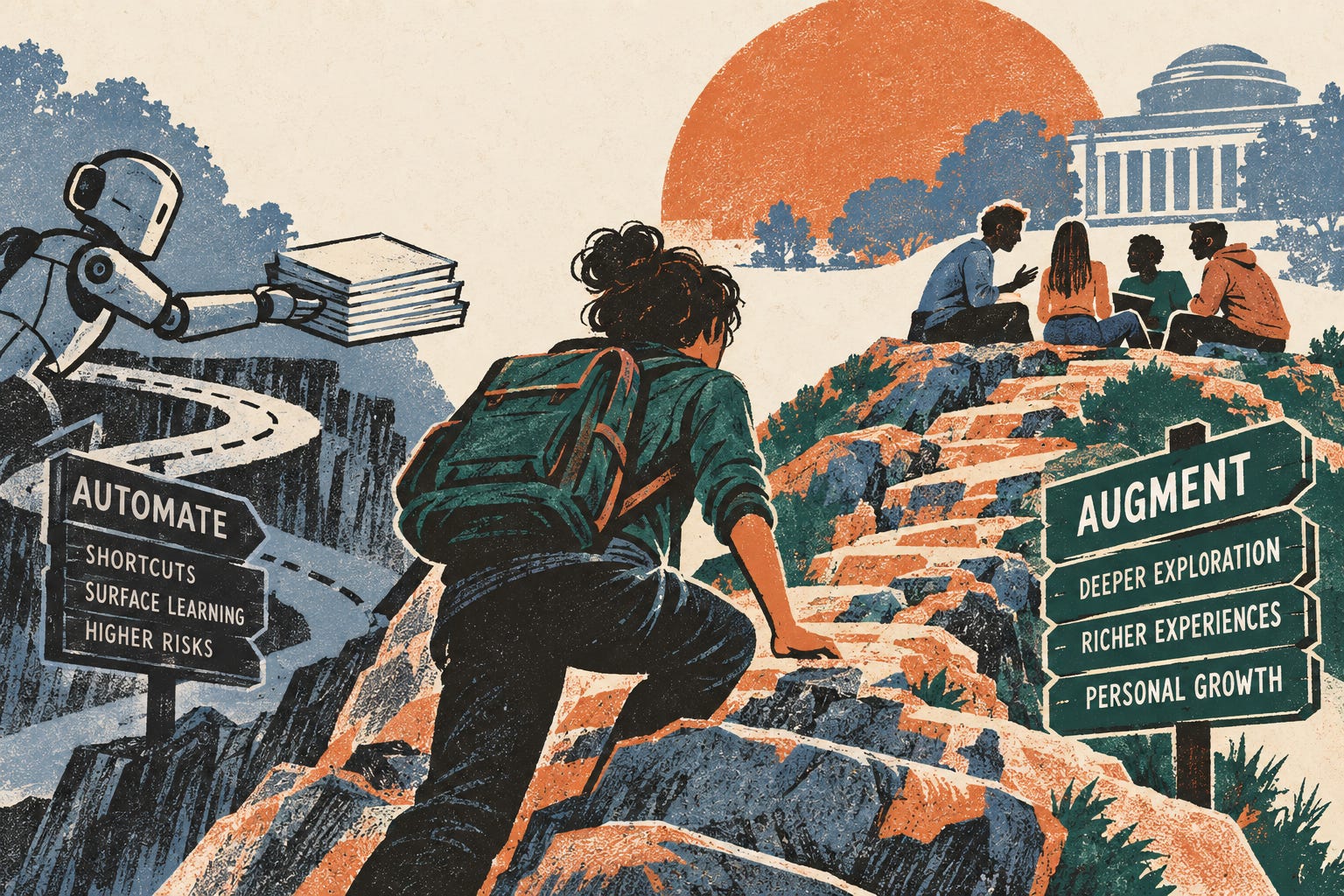
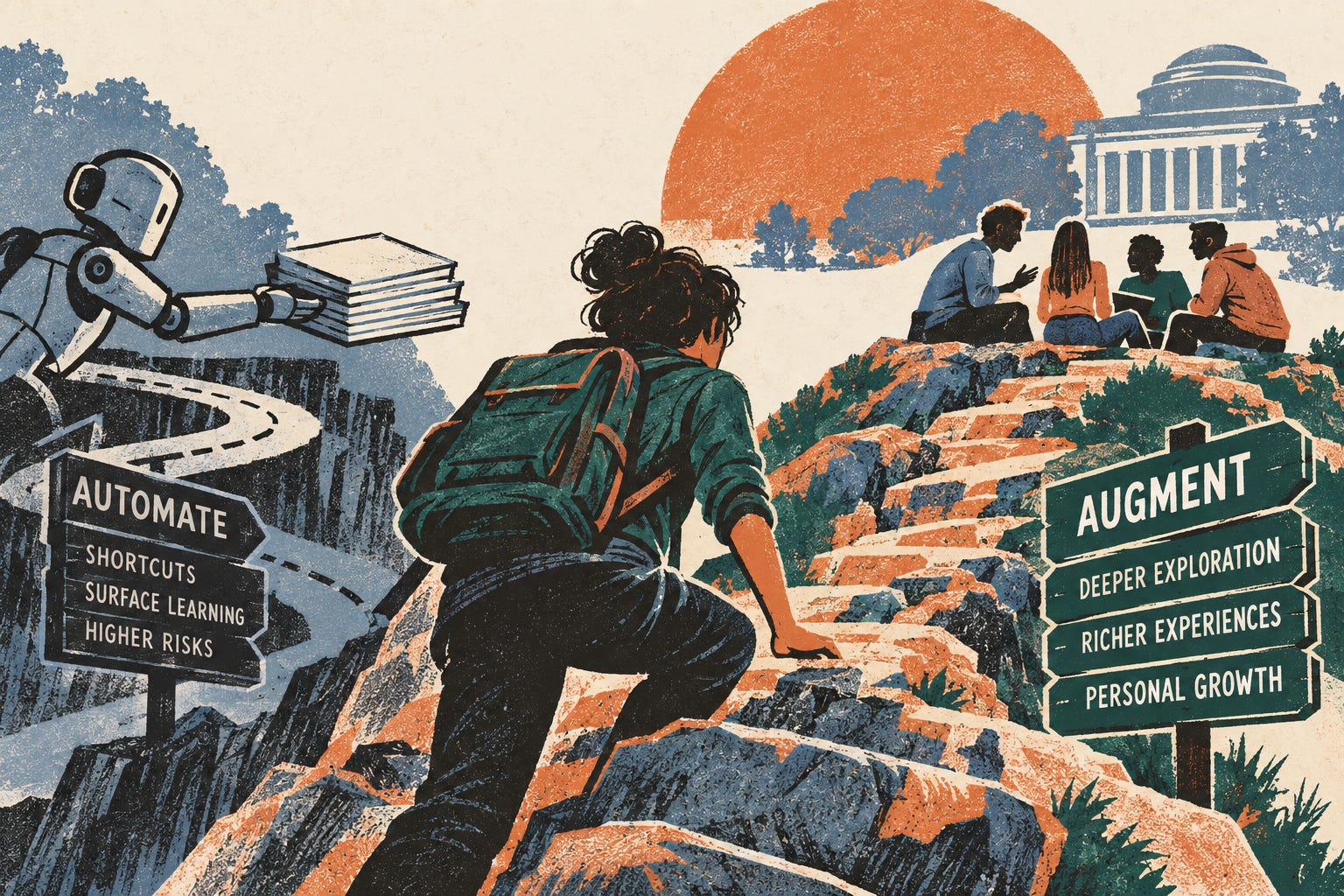
They see a lot of possibilities in what AI tools can do to augment education. Education, they argue, degrades when AI is used to automate it.
For us in the digital education space, the paper summarizes a lot of core educational philosophy that we can and should bring into the materials we’re creating. AI can and should be used. But the Ad Hoc Committee urges us to do so thoughtfully and intentionally.
While the paper is focused on AI’s impact on education at MIT, much of it is transferrable to any learning institution and it is rich with ideas for any instructional designer, teacher, and student. Definitely worth reading in full.