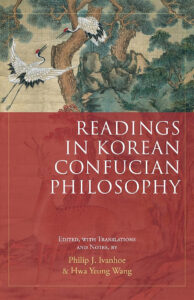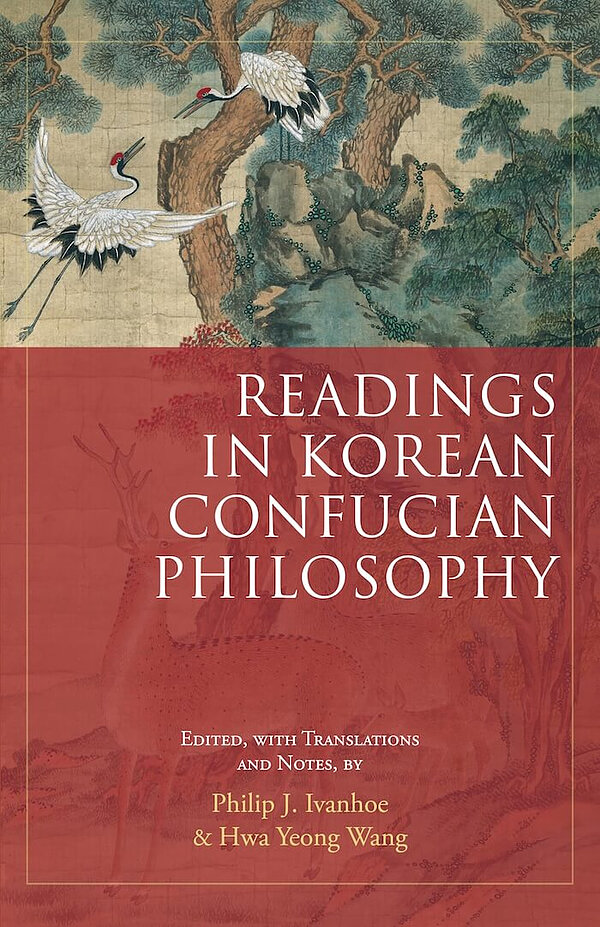
When I first held Ivanhoe and Wang’s Readings in Korean Confucian Philosophy in my hands and leafed through it, I immediately regretted retiring from teaching a couple of months earlier. I had taught Korean cultural history for decades but, since most of my students couldn’t read Korean or Classical Chinese, I couldn’t include substantial excerpts from the writings of Korean Confucian philosophers among the primary sources I asked them to read. Now that I was no longer teaching undergraduates, I had finally found a book with material I could have assigned. Moreover, the excerpts translated are short enough (with the exception of a lengthy translation at the end of Dasan’s reflections on Mencius) that undergraduates wouldn’t be frightened by them.
Making it even more useful for students, the book opens with a concise survey of the history of Neo-Confucianism on the Korean peninsula, focusing on the eight individuals who provide the material translated for this work. I am disappointed that the introduction doesn’t discuss the earlier history of Confucianism in Korea. However, I realize that this is probably because the earlier versions of Confucianism in Korea were not particularly philosophical. Instead, they were more concerned with government administration, history, and literature. Nevertheless, this book should have been called Readings in Korean Neo-Confucian Philosophy, since only that more philosophical version of Confucianism is covered in these pages.
Ivanhoe and Wang chose to translate excerpts from the writings of eight individuals important in shaping Korean Neo-Confucianism over the five-plus centuries of Joseon (1392-1910). The first two, Jeong Dojeon (1342-1398) and Gwon Geun (1352-1409), were major figures in the introduction of Neo-Confucianism to Korea in the late 14th and early 15th centuries. The next two, Seo Gyeongdeok (1489-1546) and Yi Eonjeok (1491-1553), helped solidify Neo-Confucianism’s presence on Korean soil by delving deeply into its core principles as articulated earlier in China. The third group consists of two of the most important philosophers in all of Joseon’s history, Yi Hwang (1501-1570) and Yi I (1536-1584). Both men are often given credit for Korean-izing Neo-Confucianism in the 16th century by focusing attention on issues which Chinese Confucians had not paid as much attention to, such as the role of emotions in stimulating behavior. Finally, the last group, Jeong Jedu (1649-1736) and Jeong Yakyong (1762-1836), were active in the second half of Joseon. They are known for pushing the boundaries of Neo-Confucian philosophy in Korea, promoting approaches which, though still undeniably Confucian, departed significantly from the mainstream.
The translations in this anthology are readable and, by and large, faithful to the original texts. However, I would have liked to have seen a better indication in the translations of key terms that Confucianism is more about doing than being, more about what happens or is done than about what is, and more about interactions than about solitary existence.[1] One example of a somewhat misleading translation is “sincerity”. In English, that term suggests an absence of deceit or hypocrisy. But the Chinese character translated here as “sincerity” (seong/cheng) means much more than that. It refers to acting in a selfless manner, doing what one is supposed to do according to the role one is playing in the situation one finds oneself in, without trying to gain some personal advantage or follow one’s personal predilections. Because “sincerity” is such an important term in the revered classic The Doctrine of the Mean, it appears in the writings of all eight men featured in this anthology. Gwon Geun, when explaining Neo-Confucianism to his students, told them that sincerity encompasses the different ways human beings act appropriately, saying it referred to the “actual cycle of operations” of major human virtues (55). Readers should have been reminded of that active sense of sincerity when that term reappears in this book.
“Pattern” (i/li) is another problematic translation. It does mean pattern, but it is more dynamic than that translation alone suggests. It refers to normative patterns, which both define and direct appropriate actions in interactive situations. I wish Ivanhoe and Wang had been more explicit about the normative and directive nature of “pattern” and had also signaled in the way they translated that key term that it always refers to at least potential interactions. As Gwon Geon explained, “Pattern is the public-spirited Way (i.e., not some private or personal point of view)” (8). Way is their translation of Dao, which, as Ivanhoe and Wang well know, means the proper way to behave. Unfortunately, their decision to stick to the standard way of rendering those key Neo-Confucian concepts in English means that their translations do not adequately reflect the behavioral implications of these core Neo-Confucian terms.
Those are not their only translation choices which fail to reflect the dynamism I would have liked to have seen. For example, in a poem by Yi Eonjeok, “i ryun” is translated as “the unvarying standard” (136). This is an incomplete translation. “I ryun” means “the unvarying ethical standards”, the fundamental guidelines for human interactions. Similarly, they translate Yi I as defining human nature as “humaneness, righteousness, rites, wisdom, and trustworthiness” (191). Since those five terms refers to different ways of acting appropriately, they should have been translated as verbal phrases rather than as nouns. Yi I was saying that human nature is the potential for acting in humane, righteous, polite, wise, and trustworthy manners.
Two key terms, terms which appear multiple times throughout this text, are eum and yang (C. yin and yang), which Ivanhoe and Wang wisely left untranslated. However, it would have helped readers unfamiliar with Confucian ways of thinking if they had explained the eum and yang are not things. They are instead complementary ways of interacting, with eum referring to the less active and yang to the more active. That meaning is implied in the statement by the Chinese Neo-Confucian Zhu Xi (1130-1200) cited by Yi Hwang: “The Supreme Ultimate moves and produces yang, is still and produces eum” (139).
These quibbles of mine do not mean that I disagree with their translation choices overall. In fact, I may borrow for my own work their “reverential attention” for gyeong (C. jing) and “sympathetic concern” for seo (C. shu). Nor does my preference for more action-oriented translations mean that I would be uncomfortable assigning this to undergraduates. Far from it. I like the wide range of material included, from poetry and letters to philosophical essays and civil service exam policy questions. And I was pleased to see that they even include such visual aids to understanding Neo-Confucianism as the “Chart of the Human Heart-mind and the Heart-mind of the Way” (195).
However, it would have been helpful to those more familiar with Western philosophy than with traditional East Asian philosophy if the translators had pointed out in their introduction how philosophy was done differently in East Asia. Epistemology, ontology, and formal logic were not of much concern. Instead, Confucian philosophers were more concerned with questions of ethics, of how we should behave and how we can discipline ourselves to behave the way we should behave. Even their cosmology, if we can call it that, was more about the fundamental processes, not the fundamental things, which constitute the universe. Even the Confucian description of how the universe came to be is not intended to be chronological. Instead, it is intended to show how everything is related to everything else, that everything has its roots in the stillness behind motion.
The translators could also have let their readers know that much Korean Confucian philosophizing consisted of interpretations of earlier Confucian works, primarily the ancient Chinese Classics, as well as the writings of the Song dynasty (960-1279) scholars in China who systemized Neo-Confucianism. That is implied when they identify the Chinese sources drawn upon by the writers they translate. As can be seen in the translations, Korean Neo-Confucian philosophers interacted with earlier Chinese texts when they laid out their philosophical arguments. It is important, if we want to understand why they say what they say, to know who and what they are relating to. That is why naming their sources is helpful.
That said, I would have preferred to see the names of those Chinese philosophers cited here provided in the romanization of the Chinese pronunciation of their names rather than the Korean pronunciation. Many people who will avail themselves of the translations in this anthology will be more familiar with Chinese Confucianism than with Korean Confucianism and therefore will be puzzled when they encounter the name Ju Hui, whom they would more easily recognize as Zhu Xi, or the name Jeong Ho, whom they would more easily recognize as Cheng Hao. The translators do provide the Chinese pronunciation of key names and terms in parentheses after the first use of the Korean romanization, but readers may skip around among the various translated selections and may therefore miss seeing the more familiar Chinese way of pronouncing those names and terms.
Nevertheless, the pluses of this book far outweigh any minuses. There is much readers can learn from this first-of-its-kind collection of translations of selections from the writings of Korea’s most important Neo-Confucian philosophers. One theme careful readers will notice running through these selections is tension over where li (“pattern”) can be found. Jeong Jedu insists that li operates only within the human heart-mind. Li may tell us how to interact with the external world, but it is not found in the external world. That may be because, for Jeong, li stimulates and directs moral behavior and only human beings can be moral (239-244). Yi Hwang, on the other hand, insists that li exists within everything, human or otherwise. For Yi Hwang, though li and the matter which coagulates into things need to be analytically distinguished, material objects cannot take the shape they have or operate the way they do without their own li (139-142). Yi agrees with Jeong that li is normative, but he disagrees on whether it needs consciousness to operate. Yi argued that the unconscious li in things resonates with the li in our heart-minds and tells us how to interact with them. This view that li is everywhere became the dominant position in Chosŏn, as we can see in Jeong Yakyong’s insistence that “Dogs have the pattern of dogs. Oxen have the patterns of oxen. There clearly are not in me” (327).
It is important to know where to look for li since it is only by identifying the li applicable in a particular situation that we can act appropriately. Philosophy, both in the East and the West, is the search for knowledge. But what does knowledge mean to Korean Confucians? Knowledge for them is primarily knowledge of li, of knowing how to act. This is not epistemology. It is not questioning how we know but discussing how we ensure that our knowledge is an accurate guide to appropriate behavior.
Once we know how we should act, Neo-Confucians insist we have to act that way. It is clear in the selections in this anthology that Neo-Confucianism is an ethical philosophy. It is all about learning how to act appropriately and then disciplining ourselves to act appropriately. What does acting appropriately mean to a Neo-Confucian thinker? It means acting selflessly, putting the common good ahead of any personal benefit or advantage. To ensure you do that, you have to minimize your selfish thoughts and emotions (329-330).
This practical ethical emphasis makes Korean Confucianism quite different from the way philosophy is often practiced in modern philosophy departments in the West.[2] That should be obvious to anyone who reads through the selections in this book. Despite what seem at times to be metaphysical debates, the question of how to act appropriately was always central to their discussions. The glimpses of Korean Confucian thought contained in this book reveal to those unfamiliar with traditional Korean philosophy how its issues and its approaches to solving those issues constitute a philosophical tradition which should become better known in the West. Ivanhoe and Wang have done the field a great service by making that possible.
REFERENCES
Roger T. Ames. Confucian Role Ethics: A Vocabulary. Hong Kong: Chinese University of Hong Kong, 2011.
Halla Kim, “Korean Philosophy Today: Retrospect and Prospect,” Journal of Confucian Philosophy and Culture 40 (2023): 5-29.
[1] For an analysis of Confucianism as primarily action- and interaction-oriented, see Roger T. Ames. Confucian Role Ethics: A Vocabulary. Hong Kong: Chinese University of Hong Kong, 2011.
[2] A good discussion of what makes Korean philosophy Korean can be found in Halla Kim, “Korean Philosophy Today: Retrospect and Prospect,” Journal of Confucian Philosophy and Culture 40 (2023): 5-29.