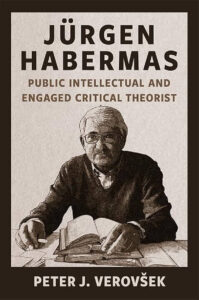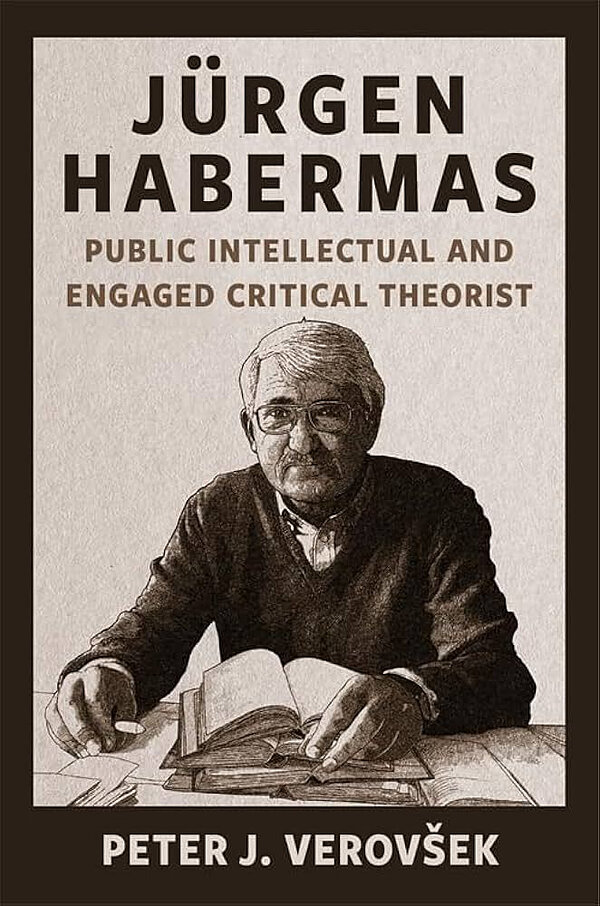
Peter Verovšek’s compendious, deeply researched, and engaging study of Jürgen Habermas’s “moonlighting career” as a public intellectual appears at a poignantly appropriate time. Habermas’s death in March of 2026, at the age of 96, brought to a close an intellectual career virtually without parallel in modern history. Habermas was all of 24 when he published an essay criticizing Martin Heidegger’s unreconstructed valuation of National Socialism, “Mit Heidegger gegen Heidegger denken” [“Thinking with Heidegger Against Heidegger”] in the Frankfurter Allgemeine Zeitung, a large-circulation national daily newspaper, in July of 1953. His last public-facing essay, defending the familiar cause of a unified Europe in the face of the collapse of the United States’s alliances under the Trump Administration, “Von hier an müssen wir alleine weitergehen” [“From Here We’ll Need to Go It Alone”], appeared in the Suddeutsche Zeiting, another major German newspaper, in November of 2025. That is a public role spanning close to three-quarters of a century.
Habermas’s fame as a public intellectual in the Federal Republic of Germany’s intellectual and political life never entirely reached American shores, where his status as a philosopher, critical theorist, and inheritor of the complex legacy of the Frankfurt School largely determined his reception. But in Germany, no fewer than four post-war generations were born and grew up with the certainty that Habermas would weigh in on the dynamics of German political culture, the legacies of National Socialism, the shifting currents of national identity, and the role of the Federal Republic in a broader “post-national” project of European unification, independently of his philosophical work. His fame as a public figure in Germany was such that he was routinely seen as Germany’s public philosopher, the “conscience of the Federal Republic”, a sort of national institution of one.
That remarkable fame was not unmixed. For decades, grumbling about Habermas’s influence on German (and European) public life provoked resentment, complaints of hegemony, of Eurocentrism and apologetics for the global liberal order, of staying too long. It’s also undeniable that, over the course of the last decade, as European and global political developments have steadily eroded the bases of post-national democracy that Habermas spent a lifetime defending, his dominance began to appear to many to be not just outdated but politically unjustifiable. That impression was powerfully deepened by one of his last public interventions, his decision to co-sign a public statement from the Normative Orders research center at Frankfurt University declaring solidarity with Israel in the aftermath of Hamas’s October 7 attack and Israel’s genocidally lethal response. Even for many of his colleagues, the statement (which offered no solidarity for Palestinian civilian victims and asserted that “Despite all the concern for the fate of the Palestinian population […] the standards of judgment slip completely when genocidal intentions are attributed to Israeli action”, an assertion that was broadly interpreted as support for continued Israeli attacks. In the weeks and months following Habermas’s death, multiple attacks from variously-motivated academics, with varying levels of competence, charged Habermas with a range of intellectual crimes, including complicity in mass murder.
Do these criticisms, as clumsy, and ill-willed as they often have been, have a point? Did modern Europe’s greatest public intellectual outlive his time? Was an uncharacteristically clumsy defense of Israel’s indefensible actions evidence of waning powers of political judgment? Or was this in microcosm a glimpse of a deeper set of problems and shortcomings with Habermas’s thought—one that would prompt a correspondingly deep reassessment both of Habermas’s philosophical legacy and his career as a public intellectual?
Answering this question adequately would require at least two endeavors, both weighty. First, we would need to understand far better the full sweep of Habermas’s political interventions, in order to see their unifying themes, their persistent problematics, their development over seventy years. Second, and still harder, we would have to understand far better the complicated relationship between Habermas’s philosophical texts and his public-facing interventions in the (primarily German) public sphere.
Regarding the first of these tasks, an exhaustive review and analysis of the full scope of Habermas’s work as a public intellectual, the book marks a significant scholarly advance. Peter Verovšek’s extensive archival research for this book unearths dozens of Habermas’s earliest works, beginning when he was still a university student attempting to make a living as a free-lance journalist in the brand-new Federal Republic.
Given Habermas’s indelible status as “der Philosoph”, reading his review of an experimental theater production or his musings on “the Musical Style of Film” can be jarring. Yet what emerges from this fascinating reconstruction of the origins of Habermas’s engagement in the embryonic political and cultural public sphere of the brand-new Federal Republic is how completely these short essays and reviews, even ones that bear only marginal political relevance, already conform with the core commitments that Habermas would never once depart from over the next seventy years. Like it or not, emerging from the moral catastrophe of global war and genocide, citizens of the Federal Republic took on an exceptional and historically specific responsibility to develop a democratic political culture out of the ashes of the worst government in recorded history, and in the near-total absence of popular embrace of the values of democratic procedure and democratic life.
For Habermas, all Germans had assumed a solemn moral injunction to keep alive the memory of the victims of their collective moral catastrophe by the practice of rigorous self-criticism regarding which national traditions, which sources of shared identity, and what forms of collective memory would be permissible, and which not. Hence everything in post-war German culture and society was profoundly political, in a deeply moral sense of democratic life. A shared duty imposed itself in both deontic and consequentialist forms: Given their unique position, Germans were obligated to do justice to the memory of Germany’s victims, and to do everything possible to construct a form of German democracy built upon the “universalistic value orientations” embodied in the nascent postwar regime of international human rights as a proactive bulwark against a slide back into the attitudes and practices that made National Socialism possible.
This highly moralized vision of post-disaster political culture explains much of the resentment, perhaps even the exhaustion, that Habermas’s politics could provoke in generations far removed from the “zero hour” of 1945; the grumbling feeling that Germany’s conscience had morphed into Germany’s over-active superego. Habermas however never wavered. Verovšek’s book is particularly masterful in reconstructing how the extended public use of reason of Habermas’s innumerable essays, speeches, opinion pieces, interviews, and other occasional writings stretched from the 1950s, through the student movement of the 1960s, the unsettled encounter with radical politics in the “German Autumn” of the late 1970s, the so-called “Historians Debate” of the mid-1980s, German reunification in the beginning of the 1990s, Germany’s complicated role in the faltering project of European legal and political unification in the early 2000s, and the specters of resurgent nationalism, unbridled technology, democratic backsliding, and the return of international war in Europe in the last years of his life.
Of course, there is more to evaluating the success of Habermas’s life work as a public intellectual than registering its nearly incredible volume and duration. Virtually all of the Enlightenment norms of deliberative democracy, the public use of reason, and “post-national” forms of political identity appear now in full retreat. Even Germany, in most regards a last European redoubt of democratic governance, shows worrying signs of stress in the rise of the far-right AfD party, resurgent nationalism, hostility toward migrants, and a healthy dose of Euro-skepticism. Did Habermas end up outliving the historical window where his political vision could survive?
Verovšek offers a careful, judicious, and guardedly optimistic response to this question. It simply cannot be disputed that the last fifteen years (at least) have seen a string of defeats for the norms that Habermas spent his public life defending. But in response to the triumphalist tone of his critics who see in his public life little more than an apologetics for Enlightenment “liberalism” and the status quo, Verovšek’s reconstruction reminds us that at virtually no point since 1945 was there any guarantee that Germany would succeed in creating a stable democratic form of collective self-rule, no taken-for-granted path toward emerging as the core of a stable democratic Europe. It did not happen by accident and could well have gone much differently, and much worse. Democracy in the post-war Federal Republic had to be made, not found. And Habermas was not just devoted to protecting and promoting a German democratic public sphere. Although he himself would never put it this way, he was personally instrumental in constructing it.
That fact—that Habermas was simultaneously defending, building, and theorizing about a work-in-progress public sphere—lies at the center of the second task mentioned above: coming to a better understanding of the complex relation between Habermas’s philosophical work and his political interventions. This is the central task of Verovšek’s book. It is also devilishly difficult.
For Verovšek, the framework for assessing the relation between theory and practical interventions rests on twin assumptions, which he both ascribes to Habermas himself and also uses as organizing principles for handling the enormous materials analyzed in the book. First, the “separation thesis”, takes seriously Habermas’s own insistence that his academic and public writings not be conflated with one another; that they arise from distinct positions of expertise and authority and differ markedly in their intended audience and effect. The “theoretical continuity thesis” balances this separation thesis with the claim that, notwithstanding the differences between theory and political practice, Habermas’s intellectual works are always and entirely consistent with the philosophical theory, hence the foundational claim that Habermas’s political writing should itself be taken as an indispensable part of the larger corpus.
Taken together the separation and continuity theses seem unproblematic—it would be odd indeed if a thinker as consistent and focused as Habermas were to find himself writing his way into a contradiction between philosophical and political positions. And the dual theses function well as a lens by which Verovšek shows how Habermas’s many political interventions interact with the developing theories of communicative action, the discourse model of participatory democracy, and the all-affected principle as a weak foundation for democratic and legal legitimacy. Among the book’s many strengths is the patience and care with which Verovšek teases out the philosophical commitments that generate Habermas’s political stances on, for instance, German national consciousness and memory politics, the dynamics of European unification, or the risk that unregulated media technologies pose for the future of a halfway-functional political public sphere.
At the same time, Verovšek’s approach does encounter some headwinds in making its case for raising the significance of Habermas’s political work. Much of those headwinds come from Habermas himself, who in interviews and essays has consistently and repeatedly downplayed the importance of his work as a public intellectual, regarding it as a mere “Nebenberuf”—a moonlighting sideline—compared to his theoretical writings. Part of this low estimation no doubt comes down to Habermas’s personal tendency toward self-deprecation. A further explanation lies in Habermas’s acute sensitivity regarding the status of the German philosopher as an elite spiritual/political shepherd, a role he experienced firsthand in his own university days in the encounter with unreformed Nazis among the German professorate.
But I wonder if there is not an even deeper reason that the separation and continuity theses in tandem may not quite capture the complexity of the relation between Habermas’s philosophy and political interventions. Verovšek is surely correct in observing that these two do not simply run along parallel and compatible tracks, but interact with one another to a degree that may be difficult to reconstruct. That interaction is probably best understood as dialectical, in the unsensational sense that interaction leaves neither unchanged, and that incompleteness or gaps in one can sometimes best be revealed by its contact with the other. Habermas was, after all, the chief theorist of the very same national political public sphere in which he spent seventy years not simply as one participant among many (despite his own humility) but among its chief architects, defenders, and contributors. And yet it takes a bit of effort to recall that the two most influential of Habermas’s theoretical works—Structural Transformation of the Public Sphere from 1962, and Theory of Communicative Action from 1981—both ended with dire diagnoses and predictions regarding the health and future of a functional public sphere. Both books saw the public sphere buckling under the weight of instrumental political and economic systems that by their very nature were not oriented toward intersubjective communication. The very transformation that Habermas had in mind in his first book on the public sphere was one of profound and possibly irreversible dysfunction. In the little-read second volume of the Theory of Communicative Action, Habermas’s penetrating diagnosis of the pathologies of political life has since been boiled down to the formula of the “inner colonization of the lifeworld”, a slogan that tends to elide the gravity of the crisis Habermas identified.
What this means is that the “theoretical continuity thesis” may need to reckon with the performative contradiction between a critical philosophy diagnosing the impending extinction of the very same public sphere, whose continued existence was in some significant part his own creation, and which was a functional necessity for his work as a public intellectual. The holistic correctness of the theory’s diagnostic appears to be in tension with the core assumptions of the political interventions—the possibility of the latter presuppose the falseness, or at least incompleteness, of the former.
But from what third position can this contradiction be comprehended? Habermas, for his part, resolutely refused to acknowledge one, leaving his own views on the relation between his theory and practice conspicuously underdetermined. Perhaps his reticence regarding the importance of his political work may register his own awareness of this and of the lack of resources to think through a theory-practice relationship consistently, without the risk of falling back into the lofty Hegelian transcendentalism he so loathed.
Whatever we may make of this problem, what is depressingly clear is the startlingly low quality of public political debate over Habermas’s legacy in the months since his death. Many interventions, even by trained philosophers, read more like Insta or X mini-rants than mature efforts to understand and convince. Inadvertently, they support the direst of his predictions of the fate of the political public sphere. It also puts into sharp contrast what we have lost in Habermas’s passing. The ideal of domination-free communication, so often derided as “unrealistically” utopian, was always for Habermas a counterfactual whose role in public discourse was most readily evident only in its absence. The conclusion of Verovšek’s book, discussing the shallowness of the online critiques of Habermas’s endorsement of the Normative Orders statement on Gaza, Israel, and the risks of violent anti-Semitism in Germany, is astute and insightful in its analysis of so many of these critiques, driven by likes and shares, many of them crudely mendacious and openly instrumental, as though a zombie version of the political public sphere, where political and economic imperatives jerk the limbs of a now-dead lifeworld, are all that is left. An authentic open debate regarding that statement, Habermas’s participation in it, and what that participation may or may not say about Habermas’s larger legacy, is badly needed. Given the decline of the public sphere that Habermas himself diagnosed, however, such a debate cannot be expected.