Aristotle’s criticisms of Plato’s theory of Ideas are among the best-known controversies in the history of metaphysics. However, the way Aristotle deals with the Platonists’ position he criticizes in his Metaphysics is troubling: he seems particularly dismissive—even ironic—and his descriptions of his opponents’ arguments sometimes seem like dry catalogs. This is where the interest of Aristotle’s Peri Ideôn (On Ideas) lies: this treatise is not simply another polemical text against Plato’s theory of Ideas, but it is the closest thing we have to Aristotle’s own reconstruction of the arguments in favour of the theory he criticized. Exemplarily, this is the approach taken by Fine (1993) in her important book on this text.
However, there is a problem. Like many works from antiquity, it did not survive in its entirety, and all our sources derive from a lengthy account provided by Alexander of Aphrodisias (around 200 CE) in his commentary on Metaphysics A.9. This raises a significant difficulty, for the status of Alexander’s account is highly ambiguous: is it composed of quotations from a single text that he had before him while writing and that he copied word for word, or is it just a paraphrase? And in the latter case, did Alexander introduce other elements into his account? If so, what is their origin: do they come from other texts by Aristotle, or from elsewhere, and in particular, are they Alexander’s own arguments? These are the questions that Michel Crubellier and Leone Gazziero’s new collective volume on Aristotle’s Peri Ideôn seeks to examine.
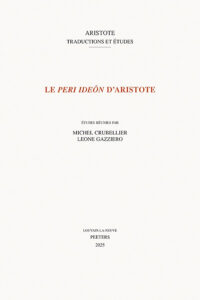
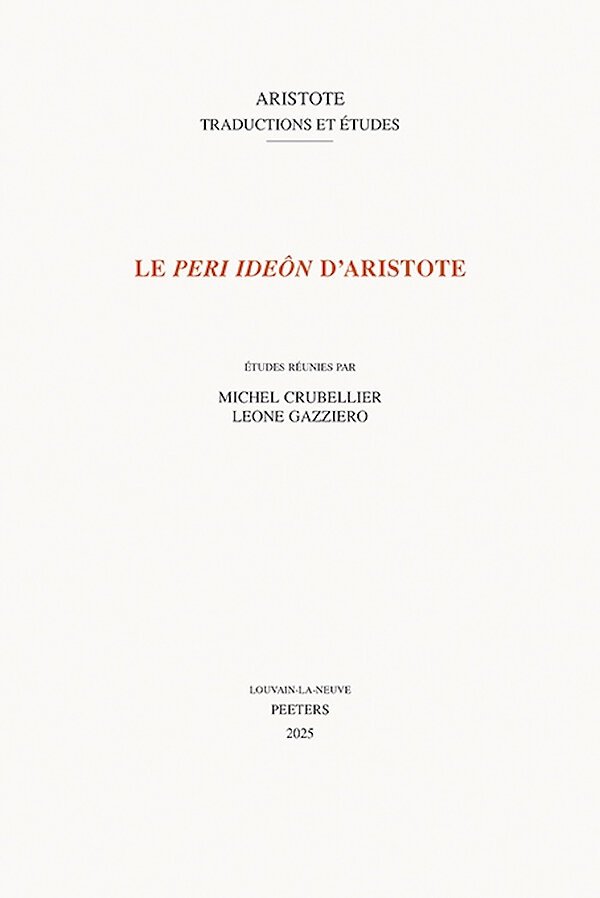
Rather than treating Alexander’s account as a transparent window onto Aristotle’s lost text—a common approach—the book asks to what extent Alexander’s report actually preserves Aristotle’s text, and to what extent it has been reshaped by Alexander’s own agenda. The volume contains a new French translation of Alexander’s account of the Peri Ideôn, alongside a slightly revised Greek text, as well as eight original studies (both in French and in English), all authored by recognized specialists of the Aristotelian tradition. Each study focuses on a specific argument in the text, and most of them analyze the argument’s logical structure: this makes the volume an excellent research tool on this lost text (as does the very up-to-date final bibliography). However, as I will explain, the studies are not all methodologically uniform.
Indeed, a clear intention is given to the volume by Leone Gazziero’s programmatic chapter (subtitled mode d’emploi, “instruction for use”), which takes the “third man” argument (84.23-85.4) as a case study: he analyzes the composition of the proposition κατ’ ἐκείνα ὑφεστάναι (84.29) to suggest that Alexander reworked his source to some degree—and therefore that questioning the reliability of his account of the Peri Ideôn as a whole is justified. However, as mentioned, the other chapters do not necessarily follow the same method outlined in this chapter, and, when they do, do not all reach the same conclusion concerning the reliability of Alexander’s account.
Let us begin with the chapters that fully embrace this approach. This is the case for Victor Gysembergh’s chapter: he reaches a very similar conclusion to Gazziero’s, studying the commentary on Metaphysics A.9, 991a8–19, where Aristotle criticizes both Anaxagoras and Eudoxus for defending a “mixture” theory of causality (i.e., Forms would cause things in the same way that white causes a white thing “once it is mixed with it”). In his commentary on this passage, Alexander presents what he describes as a list of objections against this theory, introduced by the clause ταῦτα δ’ ἂν εἴη τοιαῦτα. Victor Gysembergh shows that Alexander usually uses the optative εἶναι + τοιαῦτα structure to indicate that what follows is an illustrative construction of his own. Applied to our passage, this suggests that Alexander’s list of objections to this theory is his own elaboration rather than (or at least not directly) a word-for-word copy of the Peri Ideôn.
Michel Crubellier’s chapter follows a method similar to Leone Gazziero’s proposal, though he places far more confidence in the reliability of Alexander’s account than either Leone Gazziero or Victor Gysembergh. Michel Crubellier focuses on the argument found in lines 82.11–83.33, i.e., the so-called “argument about the equal”. He claims that, in this text, Alexander’s commentary departs from his normal exegetical habits, since here he cites the Peri Ideôn constantly and without any of the hedging language he usually attaches to his own conjectures. Michel Crubellier takes this absence of hedging as evidence that Alexander regarded the Peri Ideôn as a fully authoritative source for this passage, rather than material he was reconstructing on his own. Cautiously, Crubellier therefore advocates a reasonably high degree of confidence in Alexander’s account. The core of his contribution is to solve a textual crux on the way the argument about the equal is introduced: he maintains that we should read in lines 83.12-13 an argument that is “also” (καί) about the relatives, and not an argument that is “from” (ἐκ) the relatives; following this assumption, he then proposes a complete reconstruction of this argument.
Laura Castelli’s contribution is also partially in line with the general aim of the volume. She specifically focuses on the argument found in 85.15–88.2, that argues that the Ideas are incompatible with also being principles. Her paper has two main results: first, against some scholars who think that this passage belongs originally to the lost De Bono, she argues that it did belong to the Peri Ideôn, for the De Bono was not an anti-Platonic text, while this argument clearly is. Second, her close reconstruction of the argument shows evidence of an unresolved tension running through Aristotle’s own metaphysical commitments: she claims that the argument does not just dismiss the Ideas in favour of the Principles, but instead is a symptom of Aristotle not yet having fully settled a coherent picture of what a first principle of immobile substance should be. This is why the same unresolved tension resurfaces later, in Metaphysics Λ.
Other contributions do not engage directly with the problem of the reliability of Alexander’s account. Annick Jaulin’s chapter deals with the question of the status of the text Alexander reports, rather than the status of his account. Annick Jaulin argues that the Peri Ideôn was not a list of arguments that Aristotle himself used, but rather a disorganized collection of arguments that circulated in the early Academy, regardless of whether they were relevant to Aristotle (or Alexander) or not. In this way, the Peri Ideôn would be a compilation analogous to the Lyceum’s collections of political constitutions, but for arguments about Ideas. To prove her claim, she focuses on Alexander’s commentary on Metaphysics A.9 990a33-990b8 (i.e., Aristotle’s arguments against the Ideas), and shows that the Peri Ideôn contains arguments against the Ideas that were considered to be “completely false” by Alexander, and not just arguments he found relevant. Her general deflationary claim seems to go directly against Laura Castelli’s conclusion that some arguments of the Peri Ideôn are highly intertwined, in their formulation, with Aristotle’s metaphysical concerns.
With a very different approach, Franco Trabattoni’s chapter tackles the crucial phrase from Aristotle’s text, in Metaphysics A.9 990b15-17, about the ἀκριβέστεροι λόγοι (i.e., the more ἀκριβής arguments). In his commentary, Alexander approaches this sentence by looking into the Peri Ideôn for more rigorous arguments. Yet, according to Franco Trabattoni, he only half succeeded, for Aristotle did not use ἀκριβέστεροι in the sense of “more rigorous”, but in the sense of “more precise” or “more detailed”. In other words, the superlative bears the idea of high-resolution, rather than the idea of high-rigour. The payoff of this argument is that, according to Franco Trabattoni, Aristotle is not referring to more convincing arguments that he reported elsewhere (i.e., in the Peri Ideôn), but to Plato’s own detailed arguments in the dialogues themselves (Phaedo 74a-75, Parmenides 132a-b), which Aristotle can therefore refute without needing to spell them out. Both Annick Jaulin and Franco Trabattoni do not question the reliability of Alexander’s account, but, in different ways, the very nature of the text he quotes or refers to.
Francesco Fronterotta’s approach is very different from the rest of the volume: he examines the relevance of the content of an argument reported in the account, rather than questioning the nature of Alexander’s account. He treats the “argument from thinking” (81.25–82.9). He seems to share Fine’s (1993) general method; however, he reaches very different conclusions, for he argues that Aristotle’s first objection (82.1-6) proves too much. He argues that this objection is already addressed in Plato’s texts, even if the second argument (82.6-9) is a good one—according to him, there is a disagreement not because Plato’s argument would be weak, but because Plato and Aristotle simply hold different philosophical premises.
Walter Leszl (who is also the author of Leszl (1975), an important Italian book about the Peri Ideôn) closes the volume with a lengthy chapter which has a double purpose. First, he reassesses some position he took in his own edition of the Peri Ideôn: he now thinks that two arguments he originally included in the Peri Ideôn (i.e., the argument about incompatibility and the “totally false arguments”) do not belong to the original text. The second part of his essay concerns the ἀκριβέστεροι arguments questioned by Franco Trabattoni earlier in the volume. Like Trabattoni, he rejects Gail Fine’s idea that this expression tracks the validity of arguments. While Fine (1993, 26-27, 150-157) understands all arguments as doing the same kind of (bad) logical work, on Leszl’s reading, there are two qualitatively different kinds of failures happening: some arguments are valid, but too weak, for they only deliver ordinary universals and not proper Ideas, while others are strong enough to deliver real Ideas, but are built on false assumptions.
Overall, the volume brings together a greater diversity of methodological approaches than might initially be expected from its opening chapter, and its conclusions are quite divergent regarding the problem it raises. However, I do not believe these differences in approach or conclusion would be a flaw; quite the contrary. All these approaches are legitimate and fruitful: each study is very interesting in itself and well argued. But there is also real value in bringing them together. First, it allows the book to interest not only philosophers and philologists, but to bring them into a genuine dialogue, combining their different approaches. Second, and more importantly, it seems to demonstrate something important in itself: that the study of a text with such a complex status and difficult arguments requires a pluralistic approach to be fully understood. Upon closing the book, I believe the reader may not have reached a firm and definitive conclusion regarding the reliability of Alexander’s account as a whole—instead, whatever their initial conviction was, they will surely have at least qualified it and largely questioned it. This is clear evidence of the quality of the book. On the other hand, I believe the reader will have reached an important conclusion: a text such as the Peri Ideôn must be approached with both philosophical and philological caution and, above all, with an irreducible diversity of methods. Here certainly lies the major interest of this excellent volume, which must become an essential resource for anyone wishing to explore the Peri Ideôn.
REFERENCES
Fine, Gail (1993). On Ideas: Aristotle’s Criticism of Plato’s Theory of Forms. Oxford University Press.
Leszl, Walter (1975). Il De ideis di Aristotele e la teoria platonica delle Idee. Olschki.