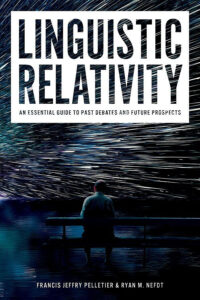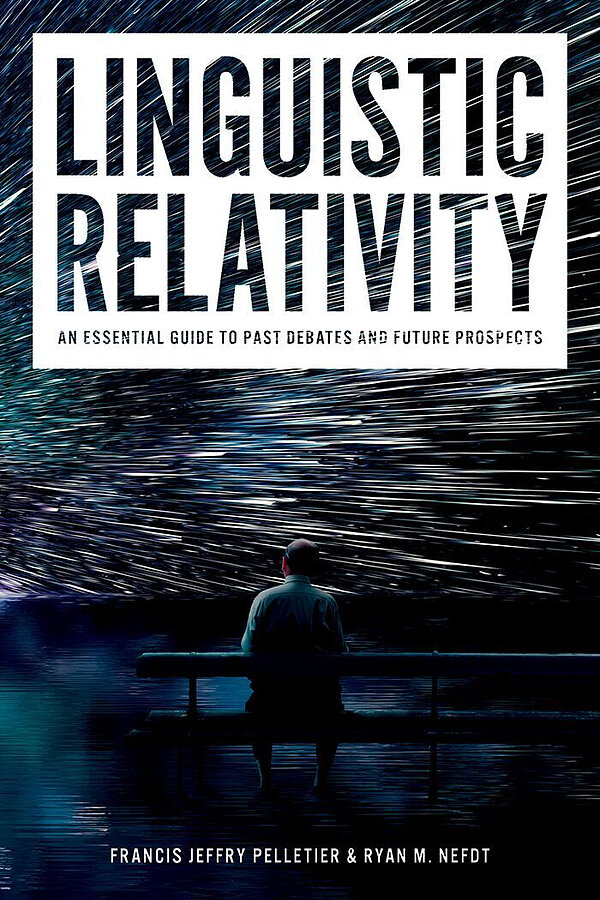
Pelletier and Nefdt’s Linguistic Relativity: An Essential Guide to Past Debates and Future Prospects is exactly what the title and subtitle suggest. It is a well-organized, largely comprehensive, and intellectually engaging survey of one of the most contested and perennially fascinating questions in the study of language and mind: does the language we speak shape, constrain, or otherwise influence the way we think about the world? The volume will serve students, researchers, and curious general readers alike as a reliable orientation to the field. That said, the book is not without its limitations, and a few of these are worth noting alongside the genuine praise it deserves.
The book opens with an introductory chapter that frames the central question and orients the reader to what follows. Chapter 1 introduces the linguistic relativity thesis—broadly understood as the claim that features of one’s native language have some bearing on one’s cognitive structures—and the authors signal from the outset that their treatment will be historically grounded, as well as philosophically and empirically attentive. This sets the tone for a book that is genuinely interdisciplinary in its aspirations.
Chapter 2 takes up the historical antecedents of linguistic relativity, and here the book makes one of its more interesting and perhaps controversial contributions. The usual suspects are dutifully presented: Johann Gottfried von Herder, Wilhelm von Humboldt, and Franz Boas. Yet Pelletier and Nefdt argue, somewhat provocatively, that none of these figures actually upheld the linguistic relativity thesis. This is a claim that will raise eyebrows among historians of linguistics, where the intellectual genealogy connecting Humboldt to the Sapir-Whorf hypothesis is often treated as secure. The authors’ revisionist reading is not unpersuasive, however, and even if one remains unconvinced, the exercise of scrutinizing the canonical lineage more carefully is a valuable one. Another contentious yet stimulating move consists in severing the development of linguistic relativity from Kantian and post-Kantian philosophy. True, for Kant the pure forms of sensibility and the categories of understanding are transcendental and therefore a priori and universal. That said, they shape experience and judgement, which is never of things in themselves. The mind, that is, makes an ineliminable contribution to the constitution of the very objects of experience and judgement. Often, Herder, Humboldt and Boas are depicted as building on the latter Kantian insight while going in search of non-transcendental elements that would shape human experience and judgment (see also Baghramian, M. and Coliva, A. 2020 Relativism, Routledge, chapter 2).
Languages, with their cultural and historical variability, were seen as promising candidates for that effect. Be that as it may, the chapter functions well as an exercise in intellectual historiography, inviting readers to distinguish between loose family resemblances and genuine theoretical commitments.
Chapter 3 is the most historically rich and engaging chapter in the book. It is devoted to the lives and works of Edward Sapir and Benjamin Lee Whorf, the two figures whose names have become practically synonymous with the linguistic relativity hypothesis. The authors make a notable claim here: that Sapir’s endorsement of the linguistic relativity thesis can be traced to no earlier than 1924, and that this development occurred independently of any direct intellectual exchange with Whorf. This historical claim, if correct, has some bearing on how we understand the so-called “Sapir-Whorf hypothesis” as a unified or collaborative doctrine—which, it turns out, it may not quite be. Equally noteworthy is the authors’ rehabilitation of Whorf as a serious linguistic thinker. The dismissal of Whorf as a mere amateur has long been a convenient rhetorical move among his critics, but Pelletier and Nefdt remind us that Whorf was, in fact, well-trained in the relevant non-Standard Average European (SAE) languages and brought genuine analytical sophistication to his comparative linguistic work. This corrective is welcome and inspiring.
One of the more intellectually stimulating moments in this chapter is the authors’ deployment of the emic/etic distinction—the difference between analyzing linguistic or cultural phenomena from the insider’s perspective, or else from an external analytical framework—as a key methodological variable. This distinction is crucial in anthropology, for instance, even though it is not without problems. For clearly the perspective of the insider seems to be at least partially precluded to the observer, who will inevitably utilize their own categories for making sense of the native. The argument here is subtle but important: the choice between emic and etic approaches to translation can substantially influence whether non-SAE languages appear radically different from SAE ones or merely superficially so. This insight, introduced here, will prove to be a recurring and productive thread throughout the book.
Chapter 4 moves from historical reconstruction to theoretical taxonomy, introducing three interpretations of the linguistic relativity thesis: minor, medial, and grand relativism. These are distinguished by the strength of the relation posited between a linguistic feature—specifically, whether feature F is obligatory in language L1 but optional or absent in L2—and some cognitive effect. Minor relativism posits only a weak relationship; grand relativism posits a strong and far-reaching one. This trichotomy is analytically useful, and the authors deploy it with precision. Also addressed in this chapter is the thorny problem of empirical testability. The influence of language on thought is notoriously difficult to isolate and measure, and even studies that have produced apparently positive results have proven frustratingly difficult to replicate. The authors attribute this, at least in part, to behavioral adjustments made by speakers of both languages under experimental conditions, as well as—returning to the earlier theme—to the effects of the emic/etic distinction on the construction and interpretation of translation tasks. This is a sober and honest assessment of where the empirical literature currently stands.
Chapter 5 is the most wide-ranging in the book and, in certain respects, the most uneven. It opens with approximately ten pages on the relationship between analytic philosophy and linguistic relativity. While this is a legitimate and potentially rewarding topic, the treatment feels somewhat superficial. The discussion focuses primarily on Frege, Russell, Ryle and Davidson—figures whose views are largely inhospitable to linguistic relativity—without sufficiently engaging with thinkers whose work might have been more fertile ground. The later Wittgenstein and Friedrich Waismann, for instance, are conspicuously absent, even though their views on meaning as use would seem directly relevant. More strikingly, Quine—whose arguments about the indeterminacy of translation and the inscrutability of reference have long been seen as at least partially congenial to relativist conclusions—receives no treatment at all. These are not minor omissions in a chapter partly devoted to analytic philosophy’s relationship with linguistic relativity.
Also somewhat underdeveloped is the chapter’s attempt to argue for a compatibility between linguistic relativity and generative linguistics. The claim is interesting and, if successfully made, would be genuinely surprising and theoretically significant. However, as Pelletier and Nefdt present it, the compatibility appears to operate only at the semantic level—a domain where generativists have traditionally been less committal—rather than at the syntactic level, which is of course where the generative tradition has staked its strongest universalist claims. The move is suggestive but would have benefited from more sustained and careful argument.
Where the chapter is more persuasive is in its treatment of Lakoff and Johnson’s work on conceptual metaphor and what has come to be known as the 4E (embodied, embedded, enacted, extended) approach to cognition. The authors make a compelling case that these frameworks are broadly hospitable to at least some form of linguistic relativism. If metaphors structure thought, and if metaphors differ significantly across languages—which they do—then there is at least an indirect route from linguistic diversity to cognitive diversity. Spatiotemporal cognition receives particular attention here, with the suggestion that different bodily experiences and cultural environments can give rise to genuinely different ways of organizing and representing the world. This is one of the more persuasive sections of the book.
The chapter closes with a discussion of whether large language models (LLMs) genuinely understand language, a question that has become impossible to avoid in any contemporary account of language and mind. The authors argue against such understanding, on the grounds that LLMs lack the embodied, worldly experiences that enable human language to refer to things in the world. The argument is brief but philosophically defensible, and it connects productively to the broader themes of the chapter.
Chapter 6 provides a structured overview of the main arguments for and against linguistic relativity. On the side of skepticism, the authors consider the Kantian position (this time—interestingly—with a question mark)—that cognitive structures are universal and therefore cannot be substantially reshaped by the contingent features of particular languages—and the Chomskyan view—equally presented with a question mark—that language itself, at its most fundamental level, is a species-wide biological endowment, leaving relatively little room for cross-linguistic cognitive variation. On the affirmative side, the case rests primarily on the profound structural differences between SAE and non-SAE languages and the plausible inference that such differences may produce different categorizations of experience and of the external world. The chapter is balanced and fair, though readers hoping for a decisive adjudication of the debate will find that none is forthcoming—which may itself be telling.
Chapter 7 serves as something of a conclusion, reviewing the ground covered and gesturing toward future directions. One curious feature of this final chapter is that it incorporates some historical background that would arguably have been more naturally placed in Chapter 2. This is a minor organizational infelicity rather than a serious fault, but it does create a slight sense of unevenness in the book’s architecture.
Pelletier and Nefdt have produced a volume that succeeds admirably in its stated aims. As a guide to past debates and prospects in the study of linguistic relativity, it is instructive, intellectually stimulating, and admirably even-handed. The historical chapters are particularly stimulating, offering revisionist readings of canonical figures that are grounded in close textual analysis and sensitive to the complexities of intellectual biography. The theoretical taxonomy introduced in Chapter 4 provides a useful vocabulary for distinguishing positions that are frequently conflated in less careful treatments of the subject.
Still, readers looking for a clear, empirically grounded argument in favor of a strong or “grand” form of linguistic relativity will not find it here—and this is perhaps less a criticism of the book than an accurate reflection of the state of the field. The honest conclusion that emerges from this survey is that decisive evidence for grand relativism remains elusive. The weaker or “minor” forms of the thesis, on the other hand, may strike many readers—particularly those fortunate enough not to be monolingual English speakers—as so obviously true as to be hardly worthy of the status of an empirical hypothesis at all. When one moves between languages and finds that certain concepts, framings, and experiences simply do not translate cleanly, one is not conducting an experiment; one is noticing something about the world. That medial linguistic relativity—i.e., that different languages may give rise to different habits of thought that affect psychological processes—requires careful empirical vindication is, in itself, an interesting sociological fact about the discipline.
These reservations aside, Linguistic Relativity: An Essential Guide to Past Debates and Future Prospects is a genuinely useful contribution to the literature. It will work well as a course text, as a scholarly reference, and as a point of entry for anyone wishing to understand why this question has fascinated—and divided—linguists, philosophers, anthropologists, and cognitive scientists for over a century.
REFERENCES
Baghramian, M. and Coliva, A. (2020) Relativism, Routledge.